Phil Robertson: “Vietnam has both the capability and the political will to abduct people abroad”
 By Doan Bao Chau
Original article in Vietnamese ↗
Đoàn Bảo Châu interviewed Phil Robertson on 17 October 2026. The interview was conducted in English and has been edited for brevity and clarity.
Mr. Nguyễn Đức Thuận (a Norwegian citizen), Mr. Trần Hiệp (an Australian citizen), and Mr. Thái Công Trường Sơn disappeared in Cambodia on 18 September 2026. \[1\] Ten days later, Vietnam announced that it was holding them on terrorism charges. I spoke about this issue with Phil Robertson, director of Asia Human Rights and Labour Advocates in Bangkok. He has worked for nearly 20 years to protect activists pursued across borders in Asia.
***
Đoàn Bảo Châu: Diplomats have finally been able to meet Mr. Thuận and Mr. Hiệp. There are reports that Mr. Hiệp told his family that he never crossed the border, and that he is psychologically traumatized and terrified. What do we learn from these visits?
Phil Robertson: The Vietnamese government finally allowed Australia and Norway consular visits. This should have happened immediately, but it took almost a month. We will probably hear very little from the diplomats, because they always cite privacy reasons. But the important thing is that information is leaking out: they did not cross the border voluntarily. This comes directly from the detainees themselves.
It shows that this is transnational repression by the Vietnamese authorities in Cambodia: a kind of arrangement to abduct people. It is like what we saw in Thailand in 2023 with Mr. Đường Văn Thái, who was abducted right on the street in Pathum Thani province, north of Bangkok.
It is clear that the Vietnamese government not only has the capability to do this but also the political will. It only needs a willing partner, and in Cambodia it has one. Hun Sen essentially returned to Cambodia on a Vietnamese tank in 1979. He has had close ties with the Communist Party of Vietnam for decades. If the Vietnamese government asked Cambodian officials to help track down these three people, I believe they were helped.
Why is Hanoi allowing a visit now? Is it because of pressure?
There is certainly pressure from Australia and Norway. Consular access is a norm worldwide. I don't believe the visits will take place regularly. The Vietnamese government will try to restrict them as much as possible.
This may also be linked to the EFTA free trade agreement that Vietnam will sign tomorrow [i.e., 18 October – reporter] with four European countries that are not members of the European Union. I think Norway pressed for Vietnam to allow a visit before its senior officials arrive in Hanoi for the signing ceremony. The Vietnamese authorities respond to that kind of pressure, when they stand to lose something.
But let me be clear: this should have happened in the first days after their arrest, not a month later. The Vietnamese government deliberately dragged its feet.
Unfortunately, the Vietnamese government regards Vietnamese people anywhere in the world as falling under its control. Even if they hold another nationality, Vietnam still considers them its citizens and wants to do whatever it likes with them. The world should not work like that. But that is how the Communist Party of Vietnam thinks.
Why did it take almost a month, when Vietnam has committed to this norm?
The Vietnamese authorities treat access for relatives, lawyers or foreign diplomats as something they grant when they feel like it. When the police arrest someone, there is an investigation phase, and Vietnamese law allows the authorities to deny the family or lawyers access during that phase.
We have also seen that the investigation phase is when torture of activists and detainees happens most, because the police are trying to force confessions. When I worked at Human Rights Watch, in 2014 we published the report "Public Insecurity" about deaths in police custody in Vietnam. [2] The Ministry of Public Security regards the investigation phase as its own domain. No one gets access. I am certain that this way of thinking is being applied to these three men.
Perhaps the pressure comes not only from these two governments but also from other countries, in the vein of "Come on, these are foreign citizens, they have to be given consular visits." So in the end they had to give way. But I expect that access will be erratic, not regular.
Some Vietnamese readers find it hard to believe that the police torture people. Can you say more?
There is a consistent pattern of torture and deaths in custody. The Vietnamese police have a long history of this, and it is tied to how they conduct investigations. Their methods are very crude: interrogation and abusive interrogation, including torture. [3] The goal is to extract a confession and then hand that confession to the procuracy. Police officers are in practice rewarded for getting people to confess.
The Vietnamese government denies it, but it is lying. The Ministry of Public Security and the police torture people regularly. That is not even a matter of dispute.
Do you have evidence?
There are many testimonies from people who were tortured in detention. We produced an entire report in 2014. I believe the people rather than the Vietnamese government. And it is not only human rights activists. There are cases of young men out riding their motorbikes who passed through a checkpoint. The police chased them, beat them, took them to the station, and they ended up disabled or dead.
There is something interesting. For a few years, before To Lam came to dominate the political scene, the University of Oslo, the Norwegian police and Vietnam's Ministry of Public Security cooperated. [4] It was a pilot project to help the Vietnamese police investigate and gather evidence, rather than arrest people and beat them until they confessed. Norwegian police went to Vietnam to explain interrogation techniques, and some parts of the Ministry of Public Security were open to reform. When To Lam and the conservative faction rose, they shut it down. But what the Norwegians gathered showed that torture is a systemic problem in the criminal investigation phase.
The people most vulnerable to this kind of abuse right now are those who do not hold foreign citizenship.
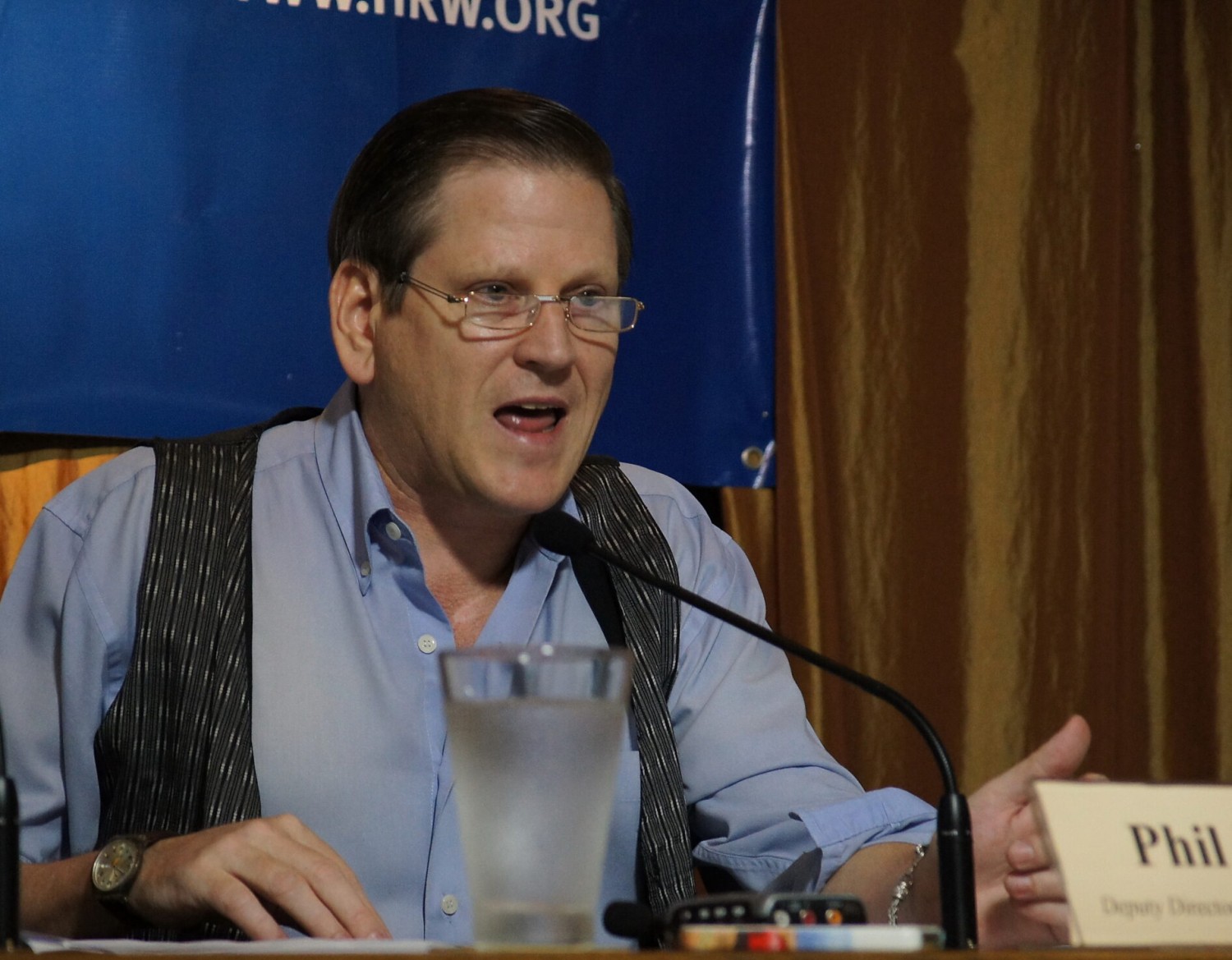
Phil Robertson at a Human Rights Watch event. Photo: the Diplomat
What do you think about Vietnam still treating overseas Vietnamese as "belonging" to it?
We have just seen Vietnam try people in absentia who are citizens of other countries. [5] Even if you leave and take another nationality, they still believe they own you. The only other country I know that does this so extensively is China. I know Vietnamese people don't like being compared to China, but the two governments behave very similarly.
The two communist parties remain close, despite the dispute over the Paracel and Spratly Islands and the anti-China riots. Vietnam's Ministry of Public Security has a close working relationship with China's Ministry of Public Security. Many Westerners do not understand this.
Vietnam has signed UN human rights conventions. Why doesn't it comply?
Vietnam signs international agreements because it thinks that makes it look better. Even though it has ratified the International Covenant on Civil and Political Rights, it still says: "We do not violate human rights, because everything is done according to Vietnamese law." But Vietnamese law contains provisions that violate those very conventions, and they don't care about the contradiction. That is the crude worldview of the Ministry of Public Security: whatever we say is right, and no one is allowed to question it.
Why isn't the international community doing more?
Because they are so eager to trade with Vietnam that they turn a blind eye to human rights violations. That makes me very angry. Norway's state secretary is probably in Hanoi right now to sign the agreement tomorrow. To Lam has visited Denmark and Belgium, where the European Union is headquartered, and has been doing business with Canada. Because of Donald Trump's tariffs, people like Canadian Prime Minister Mark Carney say: "To survive, we must diversify our trade." So they go to Vietnam. The United Kingdom after Brexit is the same.
The Vietnamese government is very eager to sign trade agreements, but does not accept any linkage between trade and human rights. And those other governments are willing to look the other way.
For Vietnamese activists sitting in prison for 6, 8, 10, 12 years, the international community is not really speaking up. Over the past 10 years, To Lam has swept away the brave activists we once saw.
Is the UN High Commissioner for Human Rights too weak?
The UN human rights office for Southeast Asia in Bangkok has enormous difficulties with Vietnam. Vietnam doesn't want them to come, so they struggle to get visas, and they are not allowed to station staff in Vietnam. The closest presence is the United Nations Development Programme (UNDP), which runs harmless technical training, such as helping the Ministry of Foreign Affairs prepare for the Universal Periodic Review (UPR). No one in the UN team in Vietnam wants to step forward to defend political prisoners. They have become very cautious.
Meanwhile, Vietnam keeps being elected to the Human Rights Council. It wants to sit there to block actions targeting Vietnam and its allies such as Russia, China and North Korea. Vietnam is the bad apple on the Council. And it is elected by the very governments that want to do business with Vietnam. It is a vicious circle.
What can we do?
First, the overseas Vietnamese community must unite against transnational repression. The people of Norway must demand that their government be tough. The people of Australia too. Otherwise these people will be held for years and face a show trial. Chau Van Kham was sentenced to 12 years and was held for four and a half years before Prime Minister Anthony Albanese traveled to Vietnam to bring him home. That is the future of these three people without major pressure. That includes Vietnamese people around the world speaking up: this is outrageous, and we will not accept the Vietnamese government terrorizing us right where we live.
Second, human rights organizations and like-minded governments need to coordinate and recognize that Vietnam's human rights situation is heading in the wrong direction. Organizations such as Amnesty International and Human Rights Watch should make Vietnam a priority country.
Third, link human rights to economic interests. Look at labor rights. Vietnam promised to allow independent trade unions in the revised 2019 Labor Code, but five or six years later there are still no implementing regulations. The European Union should raise this in enforcing the free trade agreement. A trade agreement must benefit the people of Vietnam, not only businesses.
You have worked in this field for more than 20 years. How does Vietnam today compare with 10 or 20 years ago?
The human rights and political reform movement in Vietnam has been shattered. People who stood up for the environment, religious freedom or land rights were able to organize [a movement] for a while. But since 2016 or 2017, the international consensus on pressuring Vietnam has evaporated.
Under the Obama administration, Vietnam took part in negotiating the Trans-Pacific Partnership (TPP). [6] At that time, Vietnam believed that if it did not make concessions on human rights and labor rights, the U.S. Congress would exclude it from the TPP. So Vietnam made concessions. When Trump tore up the TPP, all of America's leverage evaporated. Vietnam's leaders went to the White House not long after Trump took office and no one mentioned human rights. They realized they could crack down on human rights and still get trade agreements.
With the rise of To Lam and the Ministry of Public Security, that hard-line approach became the government's main way of treating its people. Dissidents get ever longer sentences. Their relatives are attacked. No one is allowed to mock the government: look at the man known as the "Scallion-Sprinkling Saint" [i.e., Bui Tuan Lam – reporter], who is in prison after a comic imitation of Mr. Lam eating gold-leaf-covered beef at the Salt Bae restaurant. Environmental activists are jailed on tax evasion charges or forced into exile. [7] Even the LGBTQ movement has gone quiet. Everyone is afraid. That is the new reality.
How does it compare with China?
Very similar. Xi Jinping has swept away civil society, environmental lawyers and reformers, and turned the Chinese Communist Party into a conservative party. Vietnam is doing exactly the same. The one big difference is that China controls the internet through the Great Firewall, whereas Vietnam does not. Now Vietnam has a new decree on social media. At the launch of Meta's new human rights report, they made clear that Vietnam is pressing them very hard to remove content. Ten years ago Meta still resisted. Now they simply take it down.
I don't want to be too pessimistic. The Vietnamese are very skilled and astute organizers, very resilient and tough. At the moment they are not getting much help from the international community, and that is partly our fault. We have to do more.
I am only doing a journalist's job. I ask questions. I don't make anything up. Yet Vietnam tried me in absentia and sentenced me to seven years in prison. [8] The government says organizations like yours have a distorted view of Vietnam. How can that change, when human rights organizations themselves are struggling financially?
I am very sad about what they have done to you and to other independent journalists in Vietnam. The people of Vietnam deserve to know the truth. There is a great deal of corruption, many shady deals between cronies in business and the party. Corruption is the enemy of development. Independent journalists who report what they uncover are useful to society.
The Vietnamese government does not want any story other than the one it controls. On this point it is very much like Xi Jinping: either you follow me or you get out. They even targeted a journalist from BBC News Vietnamese, whom I won't name publicly, because they don't like how the BBC reports. That is why they pursue independent journalists. That is why they drove you out. And now on Facebook, if you challenge the party, Facebook receives an order to block you.
When criticized, a government can learn and correct its mistakes, or it can silence the voice and act as if nothing happened.
Shooting the messenger. I agree. When I was at Human Rights Watch, I always said: you should thank the people who point out corruption and wrongdoing to you. They are whistleblowers. Those words were like water off a duck's back. Worse, they mobilize local groups and veterans' associations to attack dissidents, beat them, and throw rotten fermented shrimp paste at their homes. The party doesn't want to listen. The party only wants blind obedience. Everyone knows where the problems lie, but every attempt at reform is treated as a crime.
Mr. Thuan has diabetes. Reports say he is only given pills, not insulin injections, and that he also has kidney disease. Is this neglect, or a way of putting pressure on him?
Probably both. This really depends on the Norwegians. They must be very forceful, including in public. I would ask that the family be allowed to designate a doctor who can see him regularly to provide the medication he needs. International human rights law is very clear: when a government detains someone, it is responsible for that person's medical care.
If this report is true, it is neglect. One would think Vietnam would not want him to die or fall seriously ill in detention because that would embarrass them. But apparently not, at least for now. If Norway achieves nothing through private channels, it must be ready to speak publicly: we fear for our citizen, he is not receiving adequate treatment. Vietnam won't like it. Too bad. His life is at stake.
Reports say Mr. Thuan will not be allowed to meet a lawyer until the investigation ends, and that could take up to two years.
Norway and Australia must demand access to a lawyer. Normally a criminal investigation phase does not last two years. It might be three or four months, with access to a lawyer only near the end. They should have had a lawyer from the very beginning, but in Vietnam it has never been like that.
All of this is leading to a trial that is neither free nor fair, before a court that is not independent of the government or the party. It is a kangaroo court. The verdict exists before the trial opens. These are show trials, so that the authorities can claim Vietnam is a state governed by the rule of law. But Vietnamese law is not consistent with the human rights conventions that Vietnam has ratified.
Mr. Thai Cong Truong Son has no foreign passport and no one is visiting him. Who is protecting him?
We must say his name every time we talk about this case. We cannot talk only about the two men with foreign passports. The truth is that he is in great danger. They will give him a very heavy sentence. I hope Australia or Norway will also speak up for him, but I doubt it; they will focus on their consular responsibilities. So yes, he is the most vulnerable of the three.
You told ABC that this arrest was absurd and unacceptable, and that it was an abduction, even before the detainees had spoken. Why are you so sure? And has transnational repression increased under To Lam?
Yes, it has certainly increased under To Lam. There is no doubt about that.
When I speak with their families, the circumstances of the so-called illegal border crossing do not add up at all. Given the close relationship between the Cambodian People's Party and the Communist Party of Vietnam, if Vietnam asked Cambodia to watch, monitor or trace someone, they would be helped.
I was directly involved in investigating the disappearance of Mr. Duong Van Thai in Thailand. I saw a video of him being abducted and forced into a vehicle. A Thai military intelligence officer showed it to me. The Thais who investigated that case were not supposed to: the Vietnamese side didn't ask the Thai government, they just did it. That shows their brazenness. The Thais even found the Thai driver involved, and he told them everything.
That shows Vietnam has both the capability and the political will to carry out these operations in neighboring countries. They did it in Thailand, where relations are not as close as with Cambodia. And these activists went right up to the Vietnam–Cambodia border. You could say they went too close to the tiger's den. People from the Vietnamese side cross that border all the time.
My personal belief is that the abduction was probably carried out by the Vietnamese side. They don't need Cambodians to abduct people for them. They only need Cambodia to watch and tell the Vietnamese side where these people are until the moment to strike.
Vietnamese police say Mr. Thuan carried a fake ID card, but also a genuine Norwegian passport. Does that make sense?
No. Look back at the case of Mr. Duong Van Thai. He was seized in Pathum Thani, driven to Nong Khai on the border, then to Bueng Kan, and taken across into Laos. A few days later Vietnam said: he crossed the border into Ha Tinh and we arrested him; he was carrying fake documents. That is their familiar lie whenever they bring someone back through transnational repression. Afterward we saw the arrest warrant, which listed his address in Thailand. Even Vietnam's own paperwork shows they seized him in Thailand.
They don't care. They will say that a person with a Norwegian passport, who doesn't need a visa to enter Vietnam, illegally crossed the border with fake documents. They throw this case in the faces of Norway and Australia, and unfortunately diplomats say something like "we're not sure, so it may be true." All of this is meant to prevent effective intervention for these people. I don't believe it at all.
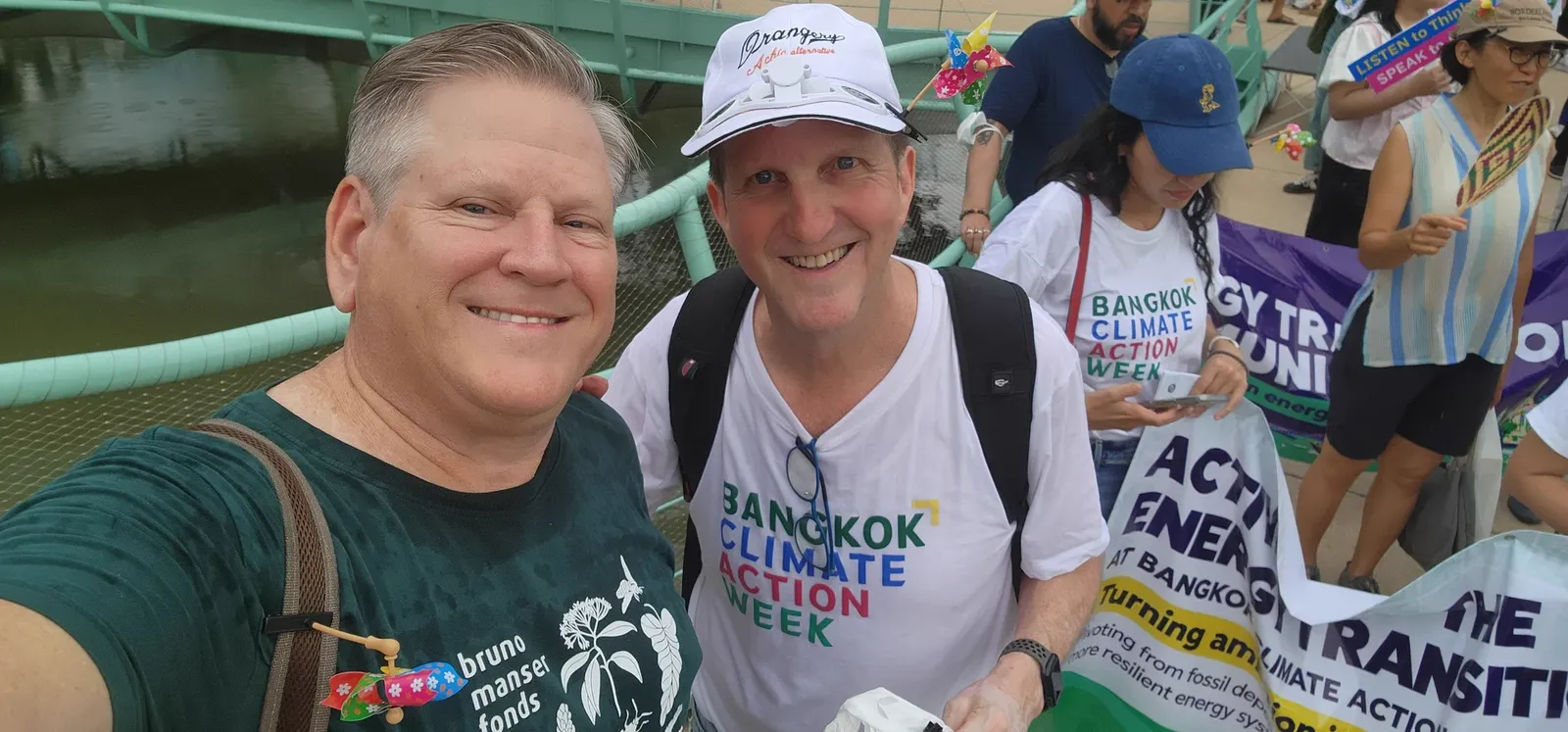
Phil Robertson at an environmental event in Bangkok, Thailand. Photo: BKKCAW
In September, you called Hanoi the cruelest transnational repressor in Southeast Asia. Is this a new line that has been crossed? And how does the so-called "swap market" work?
Yes, a new line has been crossed: abducting foreign citizens in a third country. Mr. Chau Van Kham, the Australian who was arrested earlier, admitted that he crossed the border into Vietnam. That is different from being seized in Cambodia.
The phrase "swap market" came out of Thailand under the military government. The Thai government struck a bargain: you want dissidents who fled to my country? Fine, but you owe me a favor, either pay me or return the people I want. We saw this with China, Vietnam, Cambodia and Laos. In one case, a Cambodian was seized in front of the Dutch embassy and sent back very quickly. A day later, a Thai "Black Shirt" who had fled to Cambodia turned up at the border and was handed over. A swap in the literal sense. Both sides deny it. Behind it are secret agreements, including one between Thailand and Vietnam on extraditing citizens that we have never been allowed to see.
That is part of the reason behind the effort to bring Mr. Y Quynh Bdap back. [9] Vietnam wanted him, the Thai government talked to prosecutors and judges, and he was sent back. This happened even though he is clearly a refugee with a well-founded fear of persecution, and even though it violated Thailand's own law against enforced disappearance.
Are the Truong Duy Nhat case and the Duong Van Thai case different?
Yes. In Mr. Duong Van Thai's case, the Thai government was not involved. In Mr. Truong Duy Nhat's case, it was. [10] He was held at a shopping mall. Thai police took him to dinner while waiting for the Vietnamese side to arrive and take custody. His last meal in freedom before being handed over. That was a "swap market" deal.
Mr. Kham was freed after four years of campaigning. Is that the realistic path, or could it be faster? And have other governments, such as Canada, done enough?
I think there will certainly be a trial, and they will probably receive long sentences. Vietnam has declared Viet Tan [i.e., the Vietnam Reform Party, an overseas political organization – reporter] a terrorist organization and claims they took part in terrorism. Everything depends on whether Australia and Norway are truly willing to fight.
Other governments won't get involved unless Australia and Norway invite them. Canada, the U.S., Germany and France will ask for information and offer help, but out of diplomatic courtesy they let the other countries lead.
The problem is that Australia's approach has always been gentle, gentle, quiet, quiet. They don't apply the level of pressure that is needed. Norway may feel it has little influence and wants to sign a trade agreement. But Norway has to be ready to speak out publicly if its citizen is not getting adequate treatment for his diabetes. This is a matter of life and death. If you are tough with the Vietnamese side, you will be respected more.
I have argued with Australian diplomats about this many times. They never want to speak publicly. I tell them: you are getting nowhere, you are being bullied by governments like Vietnam's and Cambodia's. Look at the case of James Ricketson, an Australian jailed in Cambodia, accused of espionage for flying a drone over a protest. Even then Australia could not stand up and object. That is when I spoke out very strongly. The Cambodian and Vietnamese governments didn't like it. Too bad. If governments won't speak up, I will.
Vietnam labels Viet Tan a terrorist organization, so any member can be branded a terrorist.
That is how they think. But it doesn't mean these people are terrorists. It's plainly crazy. Most people see that these terrorism accusations have no basis. Vietnam is just constructing charges to imprison them, and calling them terrorists is easier. We have also heard that the UN Special Rapporteur on human rights and counter-terrorism is sending a letter to the Vietnamese government. The letter says this violates international human rights law. So there will be a reaction from the UN system, although I don't think Vietnam cares much.
I think they do this to scare activists away from joining Viet Tan, and to mislead readers at home. But this time they have miscalculated. Norway and Australia will fight, and the lies will be exposed.
I think you're right. When I speak with people involved in this case about strategy, I tell them: you have to increase pressure on politicians in Norway and Australia. A solution comes only when Vietnam feels its relationship with these governments is threatened. Otherwise it will be a foregone conclusion.
So the only way is politics and political pressure, from Australia and Norway. They must actively defend their citizens, be ready to speak out publicly, and ask other governments to raise the case in Hanoi too. That way Vietnam will see that it cannot divide and rule the international community, and that everyone is united in demanding freedom for these people.
Thank you, Phil. For me, this is personal.
You are also a victim of transnational repression, my friend. Thank you for inviting me. I hope this conversation helps people understand what is happening.